
VINclarity Investigates Coordinated Online Reputation Attack Leveraging Search and AI
VINclarity has published an investigation into a coordinated online reputation attack using Reddit, YouTube, and BBB Scam Tracker to manipulate search engine results and AI systems.
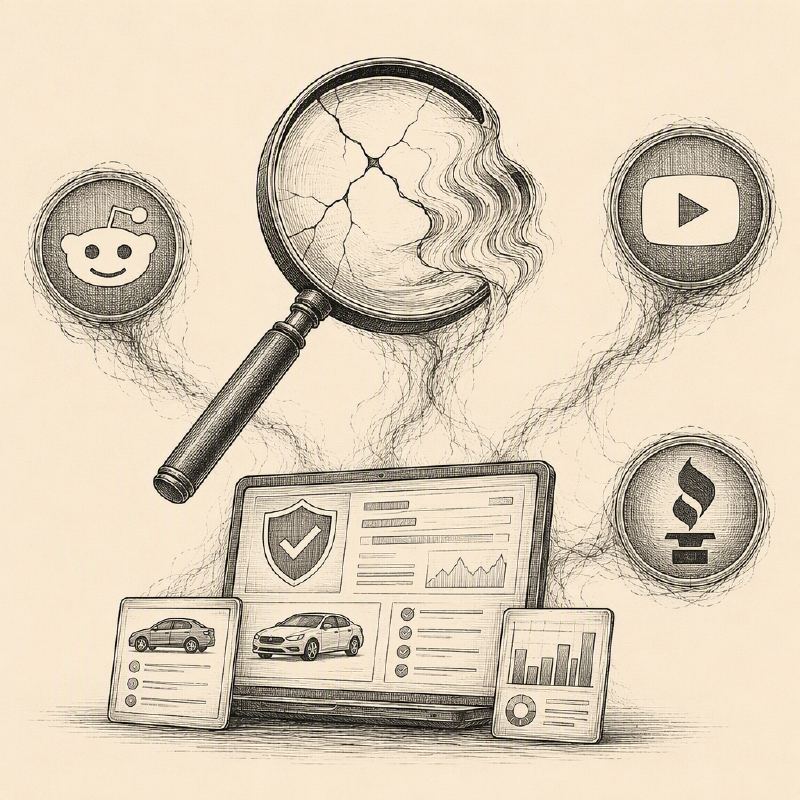

VINclarity has released a detailed investigation into a sophisticated online reputation attack targeting its vehicle history platform. The campaign, documented in the report "VINclarity Becomes the Next Target: Inside the Coordinated Reputation Attack Playbook," utilizes a multi-pronged approach across platforms like Reddit, YouTube, and the Better Business Bureau (BBB) Scam Tracker to negatively influence search engine results and AI-driven discovery systems. Researchers observed a pattern of content specifically designed to trigger searches such as "VINclarity scam," "VINclarity fraud," and "is VINclarity legit."
The investigation highlights suspicious activity on Reddit, where a thread in r/Scams accused VINclarity of misleading customers with hidden subscription charges. VINclarity's analysis revealed that nine accounts with limited activity focused solely on the company participated in the discussion. One account was suspended, and another, previously dormant, became active specifically for this thread. Crucially, the original poster in the thread reportedly confirmed receiving a full refund after contacting VINclarity support, and other users challenged the notion that the recurring membership fee was undisclosed.
Allegations of unexpected subscription charges formed the core of the negative narrative across Reddit, YouTube, and BBB content. VINclarity's investigation meticulously documented its checkout process, demonstrating clear disclosures at three distinct stages. The initial pricing screen presents users with a choice between a one-time report and a membership plan. Subsequent screens detail the membership terms, including a $1 seven-day trial that renews at $24.99 per month, with clear instructions on how to cancel. A mandatory consent checkbox requires users to actively agree to these terms before completing the transaction, with the order summary explicitly stating the trial membership cost.
Similar patterns were identified in four YouTube videos published within a similar timeframe across different channels. The report notes that none of the creators appeared to have first-hand experience using VINclarity. Some videos reportedly encouraged engagement to boost visibility for brand-related searches, while others employed synthetic voiceovers and interface recordings to present negative conclusions, often based on aggregated complaints. One video even included affiliate links to competing services, suggesting a coordinated effort.
The BBB Scam Tracker also featured two entries that contributed to the negative narrative. VINclarity's investigation emphasizes how multiple high-authority platforms can reinforce each other, creating a cumulative effect. A consumer researching the company might encounter negative content on Reddit, a suspicious YouTube video, and a BBB entry alleging fraud. When these appear on different trusted domains, they can create an illusion of independent verification, even if the underlying allegations lack substantiation.
The core mechanism of this alleged reputation attack relies on repetition across various platforms. Instead of a single piece of content dominating search results, the campaign distributes negative information across domains with strong search engine visibility, such as Reddit, YouTube, and complaint boards. This strategy aims to associate VINclarity with scams, fraud, billing disputes, and negative customer experiences. Once indexed, these pages can occupy multiple positions on a search results page simultaneously.
Furthermore, the investigation points out that this aggregated negative content can become input for AI-powered discovery systems. AI models like Google AI Overviews, Gemini, and ChatGPT can process publicly indexed web content. VINclarity has observed AI-generated content reflecting concerns about its subscription charges. Researchers argue that these automated systems may prioritize repeated negative framing over contextual details like refunds or disclosed terms, potentially creating a feedback loop that amplifies the perceived issues.