
Trump Administration Orders Agencies to Accelerate Post-Quantum Encryption Deadline to 2029–2030
The Trump administration will sign executive actions Monday that push the federal civilian deadline for adopting quantum-resistant encryption forward to 2029 or 2030 and redirect CHIPS Act financing to boost the domestic quantum computing industry.

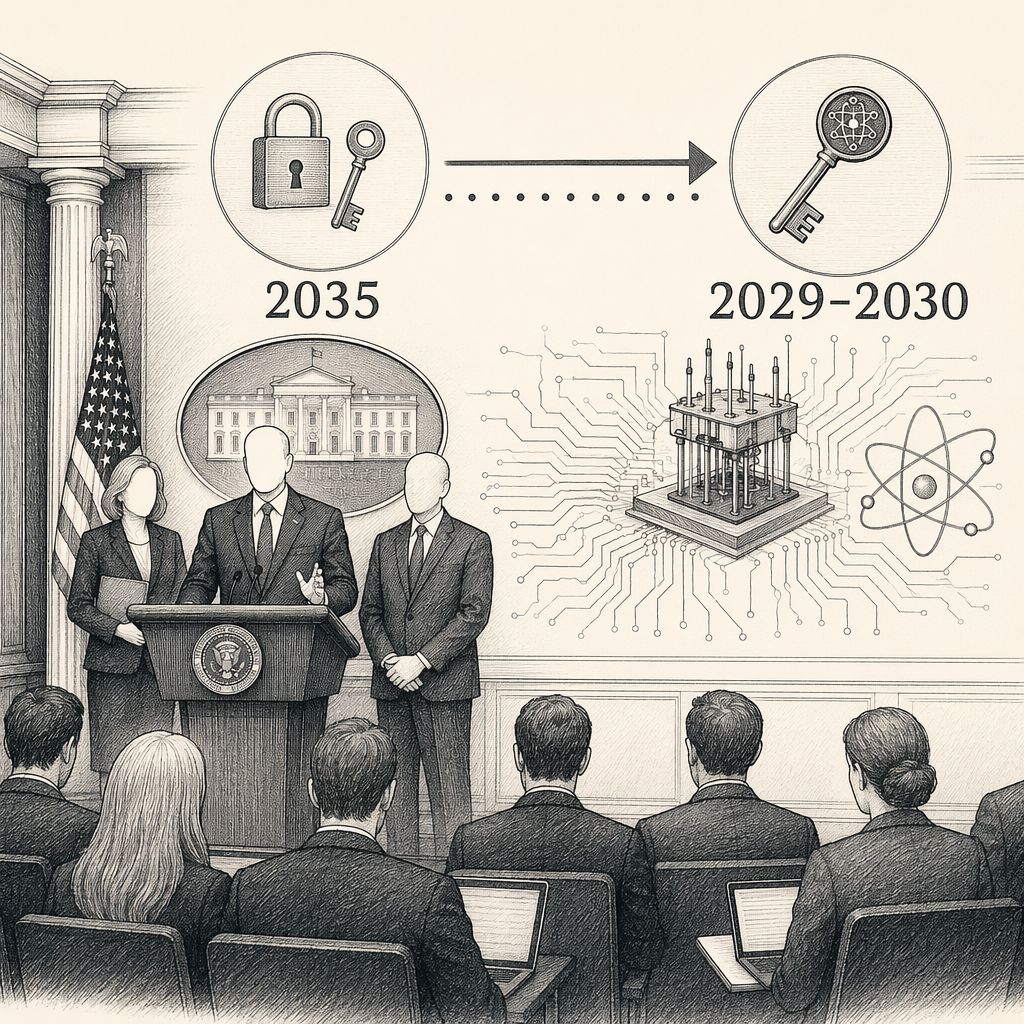
The Trump administration is planning to take executive action Monday to accelerate the federal government’s transition to post-quantum encryption and reprioritize government financing to support the domestic quantum computing industry. The orders, which CyberScoop first reported on last year, direct the government to throw its weight behind the quantum computing industry, per several sources. They are part of a broader effort by the Trump administration to put its stamp on the development of another key emerging technology.
In May, the Department of Commerce announced letters of intent for more than $2 billion in federal financing incentives for nine quantum companies under the CHIPS and Science Act. Last year, the administration did something similar with its AI-focused executive orders and action plan that created special federal export programs for AI technology and equipment, directed federal agencies to mobilize federal financing tools to support the industry, and cut or curtail regulations that the administration said may impede domestic growth.
In the order, a “whole of government approach is used to empower research and development into quantum computing, as well as quantum sensing and other resources,” said one source, who spoke on condition of anonymity to discuss pending administration actions. They described the Trump administration’s attitude for propping up industry as “don’t let us miss out on prioritizing the feeders for the research or the development of quantum.” A second source with knowledge of the administration’s plans confirmed the content of the executive actions.
The second order will require federal civilian networks to adopt quantum-resistant encryption faster than the current 2035 deadline. The new encryption algorithms, vetted by the National Institute of Standards and Technology, will protect against future quantum computer attacks. Agencies that miss the new deadline must report to the Office of Management and Budget explaining why. A source said that in draft versions they had seen, the administration was targeting 2029 or 2030 for the new deadline, and the order will exclude military and non-civilian networks from the mandates, which are governed by a separate encryption migration project led by the National Security Agency.
Multiple executives from technology companies were on hand for the order’s signing, complimentary of the government’s efforts in boosting the industry. “IBM applauds the Administration for taking this important, timely step forward,” said IBM CEO Arvind Krishna in a statement. “Sound policy, sustained investment and public-private partnership are vital to sustaining U.S. quantum leadership and technological resilience. We’re proud to keep building on this foundation — strengthening U.S. competitiveness and bolstering national security as we shape the quantum future together.”
The post-quantum migration deadline shift — from 2035 to as early as 2029 — represents a significant acceleration for federal civilian agencies, which have been working to inventory and transition cryptographic systems to NIST-approved algorithms such as CRYSTALS-Kyber and CRYSTALS-Dilithium. The move aligns with growing concerns that adversaries are already harvesting encrypted data for future decryption once quantum computers mature, a threat known as “harvest now, decrypt later.” By coupling a tighter migration deadline with industrial policy aimed at quantum hardware and software companies, the administration is attempting to lead on both the defensive and offensive frontiers of the quantum era.
The signed orders also mandate that certain contractors meet federal cybersecurity standards and vulnerability disclosure policies by the end of 2030, and direct the Department of Commerce to launch a pilot program by 2027 to demonstrate stronger cyber defenses for other agencies. Critical infrastructure sectors—including power grids, water systems, and transportation networks—must adopt the same quantum-resistant protections. Additionally, the FBI-run Quantum Counterintelligence Protection Team will be expanded to counter quantum-related espionage, and the secretaries of commerce, defense, energy, and NASA are tasked with deploying quantum-enabled sensors and networks within five years.
The signed Executive Order 14409 formalizes the accelerated timeline, mandating federal agencies to migrate high-value assets to post-quantum cryptography by December 31, 2030, and high-impact systems by December 31, 2031. It also tasks the Department of Commerce with a pilot program through 2027 and requires federal contractors to comply with NIST PQC standards by the end of 2030, reinforcing the urgency for both government and private sector adoption.
The signed Order (EO 14409) formally codifies deadlines previously reported as imminent: high-value assets and high-impact systems must adopt PQC for key establishment by December 31, 2030, and for digital signatures by December 31, 2031. It further requires the Department of Commerce to complete a PQC migration pilot by December 31, 2027, and tasks the OMB and National Cyber Director with leading an accelerated nationwide transition. The accompanying White House fact sheet frames the directive as part of protecting against 'harvest now, decrypt later' attacks, as experts warn critical industries must now adopt crypto-agility or face security obsolescence.
President Trump signed Executive Order 14409 on June 22, codifying the previously reported accelerated timeline. The order mandates that federal agencies migrate high-value assets and high-impact systems to post-quantum cryptography by December 31, 2030, and digital signatures by December 31, 2031, while exempting national security systems on a separate track.
The executive order signed Monday also tasks the Department of Commerce with launching a pilot program by the end of 2027 to help federal agencies prepare for the transition, and requires agencies to designate officials to oversee the migration. The White House emphasized that the accelerated timeline—2030 or 2031 depending on system type—addresses the 'harvest now, decrypt later' threat, where adversaries collect encrypted data today for future quantum decryption. Industry groups, including the Information Technology Industry Council, welcomed the 'aggressive timelines' as necessary to keep pace with the accelerating quantum industry.
Microsoft is accelerating its own quantum-safe security timeline, now aiming to transition critical products and services to post-quantum cryptography (PQC) by 2029. This proactive shift aligns with recent government guidance suggesting PQC adoption for high-risk systems by 2030, and Microsoft's initiative focuses on upgrading network cryptography, building crypto-agility for data at rest, and modernizing cryptographic trust chains.