
Stack-Based Buffer Overflow in X.Org Server Xkb Key Types (CVE-2026-50258) Enables Local Privilege Escalation
A critical stack-based buffer overflow in X.Org Server's Xkb Key Types handling, tracked as CVE-2026-50258, allows local attackers to escalate privileges to root on affected Linux systems.

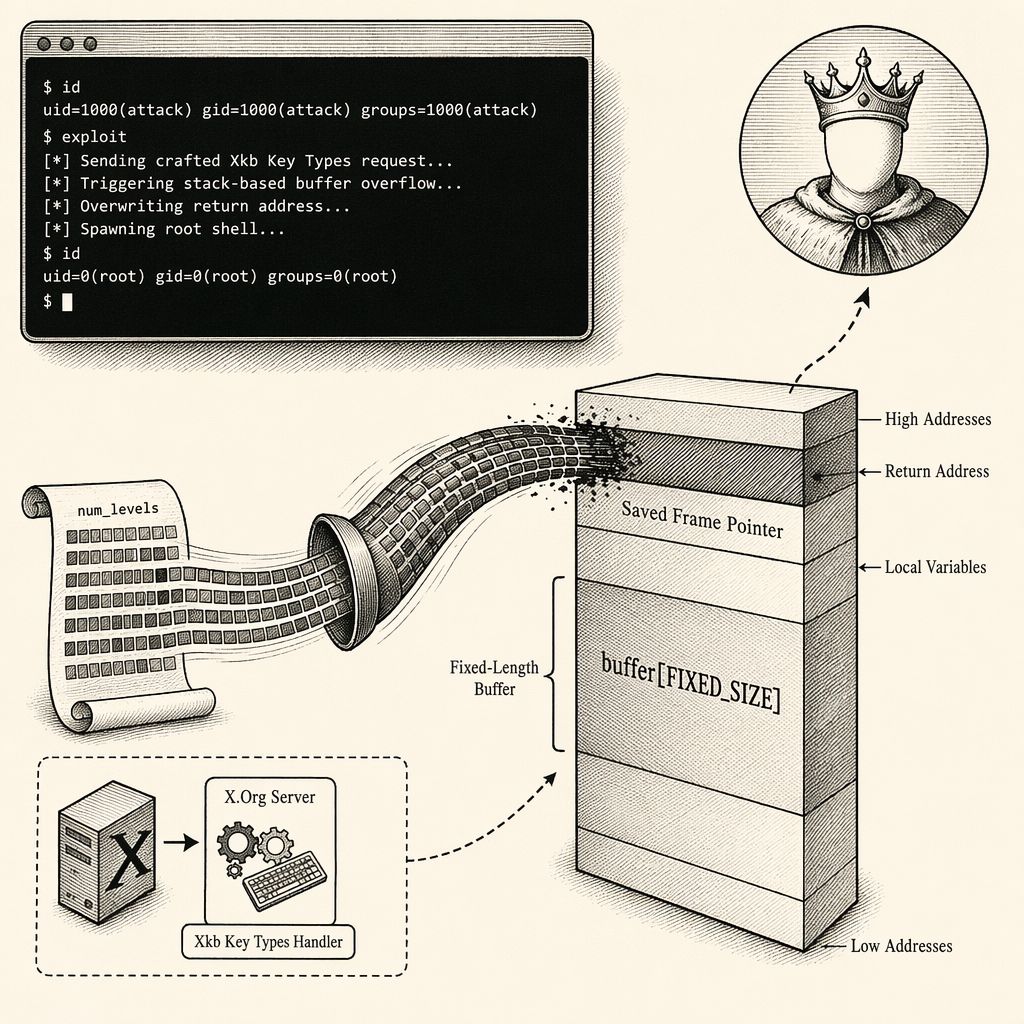
A new vulnerability disclosure from the Zero Day Initiative (ZDI) reveals a stack-based buffer overflow in the X.Org Server, the core display server for many Linux distributions. Tracked as CVE-2026-50258 and carrying a CVSS score of 7.8 (High), the flaw exists in the handling of Xkb Key Types, specifically within the num_levels field. An attacker who has already obtained the ability to execute low-privileged code on the target system can exploit this vulnerability to escalate privileges and execute arbitrary code in the context of root.
The technical root cause lies in the lack of proper validation of user-supplied data length before copying it to a fixed-length stack-based buffer. By manipulating the num_levels field, an attacker can trigger a stack-based buffer overflow, overwriting adjacent memory and ultimately hijacking execution flow. This class of vulnerability is well-understood in the X.Org codebase, which has historically contained numerous memory safety bugs due to its legacy C code and complex input handling.
X.Org Server remains widely deployed across enterprise and personal Linux systems, often running with root privileges. Any local user on a multi-user system or within a containerized environment could potentially exploit this flaw to gain full control of the host. The disclosure does not indicate active exploitation in the wild, but the availability of a public advisory and patch details lowers the barrier for crafting a working exploit.
X.Org has issued a fix via a commit to the upstream repository: gitlab.freedesktop.org/xorg/xserver/-/commit/543e108516428fc8c3bea91d6563ad266f9a801e. The disclosure timeline shows the vulnerability was reported to the vendor on April 17, 2026, with the coordinated public release occurring on June 24, 2026. Users and administrators are strongly advised to update their X.Org Server packages as soon as a patched version is available from their distribution, or apply the upstream commit if building from source.
This disclosure follows a pattern of multiple X.Org Server vulnerabilities disclosed in quick succession by ZDI, including CVE-2026-50259 (SetMap stack buffer overflow), CVE-2026-50260 (FreeCounter use-after-free), CVE-2026-50261 (SyncChangeCounter use-after-free), CVE-2026-50262 (ChangeDrawableAttributes out-of-bounds read), and CVE-2026-50263 (CreateSaverWindow use-after-free). The clustering of these flaws highlights the ongoing challenge of securing a decades-old codebase against modern privilege escalation threats.
For organizations running Linux desktops or servers with X.Org Server, the cumulative risk from these vulnerabilities underscores the importance of prompt patching. While each individual bug requires local access, a determined attacker could chain them or use one to gain a foothold and then pivot. The community should watch for further disclosures as security researchers continue to audit the X.Org codebase.