
GNOME 51 Enhances Security and Usability with Passkey Logins, Offline Maps, and PDF Signatures
The latest GNOME 51 desktop environment, codenamed 'A Coruña,' introduces significant user-facing improvements including passkey support for logins, offline maps with live transit data, and the ability to add hand-drawn signatures to PDFs.

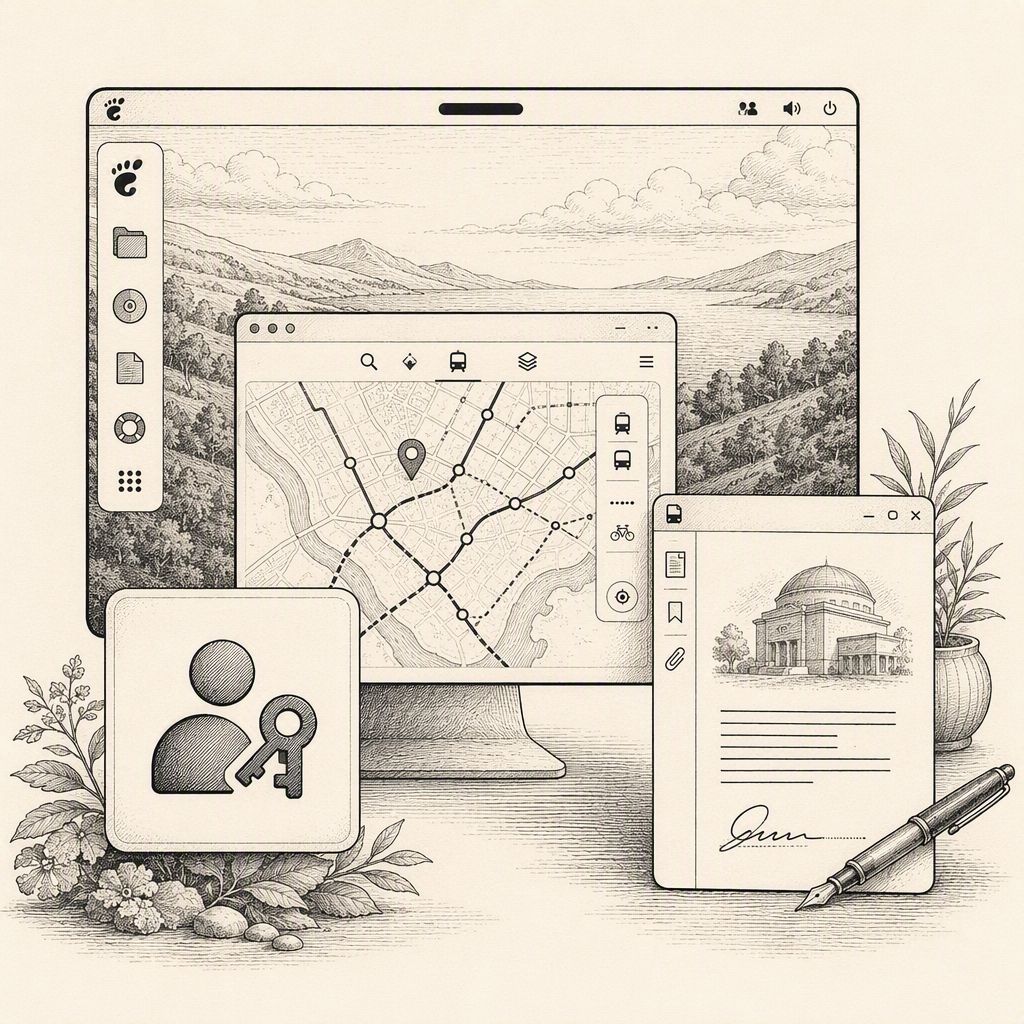
GNOME 51, released on September 16th under the codename 'A Coruña,' brings a suite of new features aimed at enhancing both security and user experience. Key among these are the integration of passkey support for system logins, a robust offline maps functionality with live transit information, and the capability to add hand-drawn signatures directly to PDF documents within the Papers viewer. This release is slated to be included in upcoming distributions such as Fedora 45 and Ubuntu 26.10.
The Maps application receives its most substantial upgrade in years, offering users the ability to download entire regions for offline use. This feature is complemented by live transit directions, providing real-time departure information, delay updates, platform hints, and estimated walking times to the nearest transit stop. This makes navigation and public transport planning significantly more reliable, even without a network connection.
Security and authentication see a notable boost with the inclusion of passkey, QR code, and smart card login options at the GDM login screen. For enterprise environments, Remote Desktop capabilities are enhanced with smart card passthrough and Kerberos authentication support. The Settings application also features a redesigned interface for fingerprint enrollment, and Remote Login now supports SSH socket servers, streamlining remote access for administrators.
The Papers document viewer gains a new signature feature, allowing users to draw signatures using a mouse or touchscreen, or import an image with automatic background removal. While this adds a visual element to document signing, the release notes caution that the signature itself does not inherently verify the signer's identity or detect subsequent modifications to the PDF, meaning it functions primarily as a visual marker.
Under the hood, GNOME's compositor, Mutter, has been optimized to ensure smoother animations even under heavy system load by improving frame scheduling. Screen recording performance is also boosted by reducing redundant buffer copies. GNOME 51 also introduces persistent monitor brightness settings across reboots and HDR toggles, and improves hybrid graphics handling for laptops with cross-GPU buffer scanout.
User interface and accessibility improvements are present throughout the system. Settings now includes Auto Rotate functionality for devices with accelerometers, an orientation lock, and an option to disable the touchpad when an external mouse is connected. Accessibility enhancements include wider support for Reduced Motion, keyboard-based screenshot area selection, and a setting to disable the focus-ring timeout. The Files (Nautilus) application sees improvements in drag-and-drop behavior, selection persistence, and responsiveness during slow operations.
However, the release also marks the removal of support for older NVIDIA graphics cards, such as the GeForce GTX 780, on the GNOME desktop. Users with these cards will be reverted to the open-source Nouveau driver, which may result in reduced functionality. This change affects most GeForce 700 series cards and older, with a few exceptions like the GTX 750 Ti. Additionally, the Network panel in Settings has dropped support for the legacy WEP Wi-Fi encryption standard.
GNOME 51 is paired with GTK 4.24, which was released on September 12th. Early adopters can experience these new features through beta releases of Fedora 45 and Ubuntu 26.10, with final releases expected in October 2026. Developers can utilize the GNOME 51 Flatpak SDK, and GNOME OS Nightly images are available for testing.