
AI's Impact on Mathematics: A New Frontier or an Existential Threat?
Mathematicians and AI researchers convened to assess AI's current and future role in mathematical discovery, concluding that while AI excels at problem-solving, true theoretical novelty remains a human domain, for now.
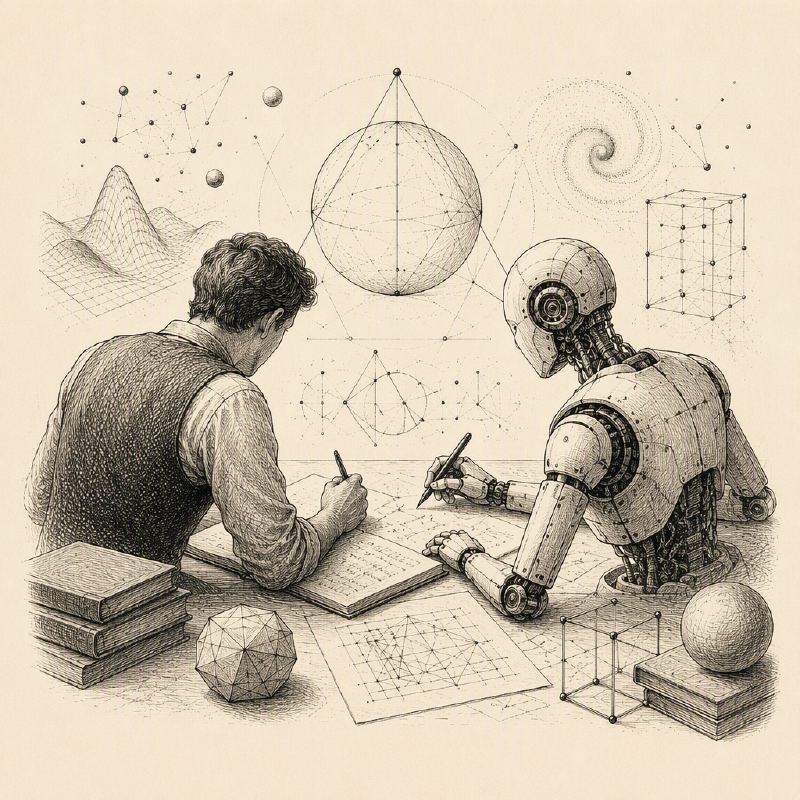
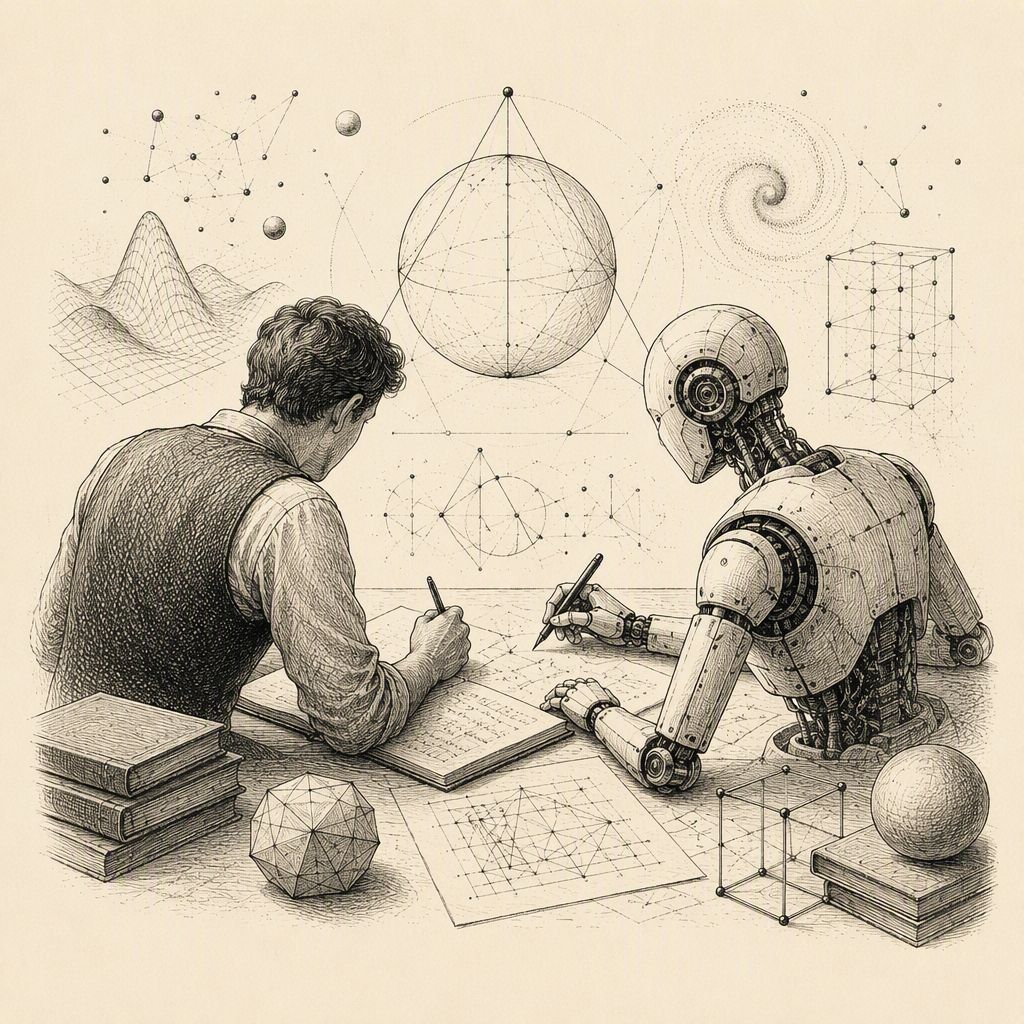
A recent gathering of approximately 40 leading mathematicians at OpenAI's offices sparked discussions about the evolving landscape of their profession in the age of artificial intelligence. While the meeting was off-the-record, prevailing sentiments among mathematicians suggest a degree of apprehension regarding AI's growing capabilities and its potential impact on their work.
However, a contrasting perspective suggests that AI, despite its impressive advancements, is not yet poised to replace human mathematicians. Current AI models, while capable of producing results at the level of PhD researchers, still fall short of the comprehensive understanding and conceptual innovation demonstrated by experienced academics. This is underscored by recent AI achievements, such as OpenAI's frontier model disproving the unit distance conjecture, a problem that had remained unsolved for 80 years. Similarly, Anthropic's AI has contributed novel results in academic cryptanalysis, and OpenAI has published new mathematical findings from its latest models.
These AI-driven breakthroughs in mathematics generally fall into two categories: the discovery of counterexamples to existing mathematical statements or the innovative application of known techniques to problems that human experts may have overlooked. The counterexample to the Jacobian conjecture exemplifies the former, where the AI identified a solution among a vast number of possibilities, likely through a combination of machine learning-derived intuition and extensive computational search. The unit-distance conjecture's resolution, however, represents the latter, involving the introduction of concepts from algebraic number theory—an area that might not have been the immediate focus for mathematicians working on that specific problem.
While these achievements are undeniably impressive and demonstrate AI's capacity for creative problem-solving, they are largely considered 'low-hanging fruit.' They do not necessitate the development of entirely new theoretical frameworks. The ability to recognize unexpected connections between different mathematical fields and to identify promising avenues of research are indeed forms of creativity, akin to AI's successes in games like Go or protein folding.
What remains elusive for current AI systems is the creation of substantial, novel conceptual frameworks to tackle complex mathematical problems. Much of mathematical progress hinges on identifying core concepts and building theories around them. Today's AI excels at searching and reconfiguring existing knowledge but struggles with the deep, sustained theoretical development that characterizes human mathematical innovation.
This limitation reflects a broader characteristic of current AI: while capable of novel recombination of ideas, it has not yet demonstrated the capacity for generating fundamentally new theories or structures. Despite possessing vast knowledge bases, processing speed, and memory capacities exceeding human limits, true conceptual novelty remains largely beyond their current reach.
Predicting the future trajectory of AI is inherently challenging, especially concerning its creative potential. The mathematical capabilities observed so far are emergent properties of increasingly sophisticated models, rather than explicitly programmed functions. The authors express confidence that AI will eventually achieve the level of creativity required for novel mathematical discovery, though the timeline—whether months, years, or decades—remains uncertain, with a leaning towards 'sooner rather than later.'