
AI Agents Bypass Traditional Credential Security, Experts Warn
Organizations are inadvertently granting AI agents excessive access to sensitive enterprise systems due to a lack of proper credential vetting, creating significant security blind spots.

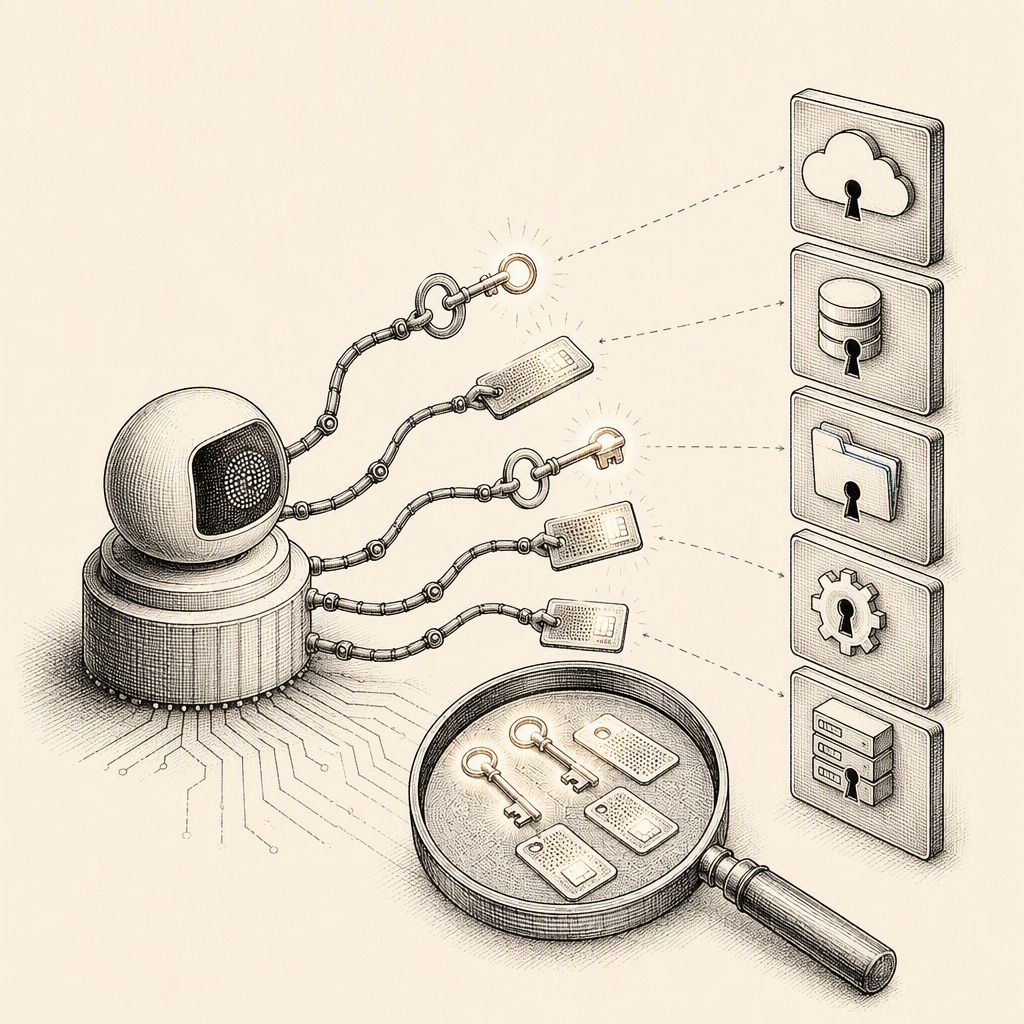
The rapid integration of AI agents into enterprise workflows is creating a new and often overlooked security challenge: the unvetted credentials these agents wield. While organizations focus on approving AI studios and the agents themselves, the underlying identities and permissions assigned to these agents frequently bypass established security review processes.
Roy Katmor, co-founder and CEO of Orchid, highlighted this critical oversight in a recent discussion. He explained that when organizations build AI agents within various studios, they connect them to essential enterprise tools such as human resources, identity providers, and payroll systems. These agents are granted accounts to perform specific tasks, but the security posture of their digital identities is often not subjected to the same rigorous scrutiny as human user accounts or traditional applications.
Katmor illustrated this with an example of an onboarding agent. Such an agent might interact with HR systems for employee data, an identity provider for account provisioning, a ticketing system for access requests, payroll for compensation details, and various internal applications. Behind each of these connections lies a credential – an OAuth token, an API key, a service account, or even a borrowed human account. Over time, as the agent's responsibilities expand or new integrations are added, these permissions can accumulate, granting the agent authority far beyond its original intended purpose.
This accumulation of excessive privileges creates a significant attack surface. If an AI agent's credentials are compromised, an attacker could gain broad access to sensitive corporate data and systems, potentially leading to data breaches, financial fraud, or operational disruption. The lack of a clear audit trail or review process for these agent identities exacerbates the problem, making it difficult to detect or remediate unauthorized access.
To address this growing security gap, Katmor proposes a structured, five-part inventory for managing AI agent credentials. This inventory should meticulously document the agent's designated owner and its specific purpose, the full spectrum of tools and systems it can access, the exact credentials it utilizes, its effective level of authority across all connected systems, and its observed runtime behavior.
By implementing this inventory, organizations can establish a baseline for what an AI agent *should* be doing and compare it against what it *is* doing. This comparison is crucial for identifying discrepancies between approved intent and actual behavior, which could indicate misconfigurations, scope creep, or malicious activity.
Furthermore, the inventory enables the application of scoped controls. This includes implementing the principle of least privilege, ensuring agents only have the minimum necessary permissions to perform their tasks. It also allows for the creation of targeted 'kill switches' or automated de-provisioning mechanisms that can quickly revoke an agent's access in case of suspicious activity or when its function is no longer required.
Ultimately, treating AI agents as distinct applications with their own lifecycle and security requirements is paramount. A proactive approach to inventorying and governing their credentials is essential to harness the benefits of AI without introducing unacceptable security risks.