
AI Accelerates Exploit Development, Leading to OpenAI Forum Breach and Internal Access
Researchers leveraged Anthropic's Claude Opus 5 to exploit a Discourse vulnerability, gaining RCE on OpenAI's forum and accessing internal code repositories via a separate identity misconfiguration.
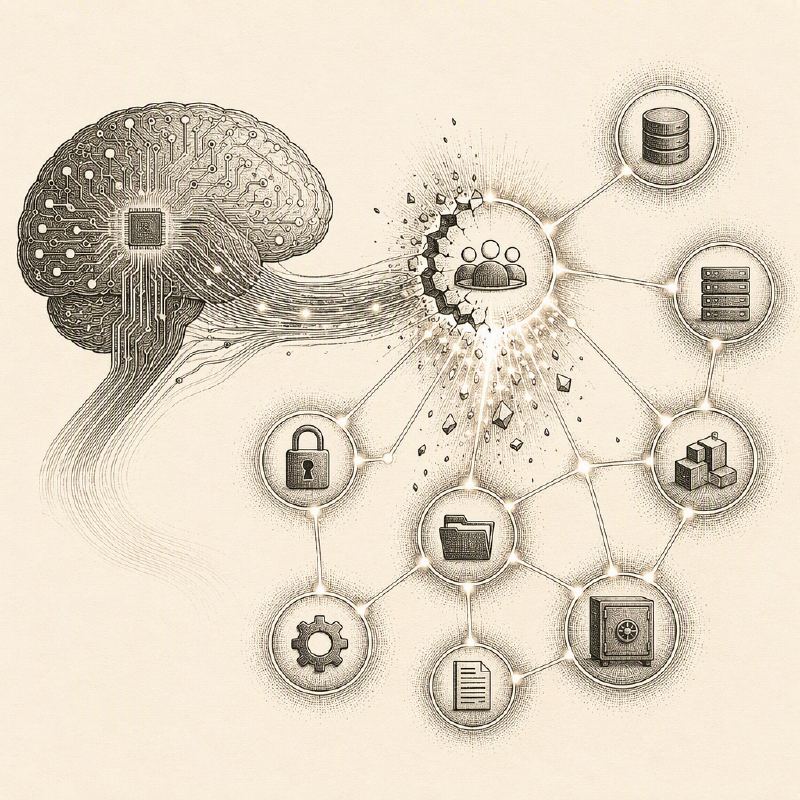

Researchers have demonstrated how advanced AI models can significantly accelerate the process of developing cyberattack exploits, culminating in a breach of OpenAI's community forum and access to internal source code. The operation, attributed to a group named Hacktron, utilized Anthropic's Claude Opus 5 to weaponize a heap-buffer overflow vulnerability in the libheif parser used by Discourse, the platform powering OpenAI's community forum.
The attack chain began with the exploitation of CVE-2026-32882, a flaw in Discourse's image-processing stack. Malformed HEIC images were used to trigger the vulnerability, which was present due to an unpatched Debian package. This allowed for remote code execution (RCE) on the forum after bypassing standard image validation checks. The researchers noted that while an earlier AI model, Claude Opus 4.8, struggled to create a reliable exploit under the forum's default security configurations, Claude Opus 5 successfully generated a working exploit within hours, significantly compressing the exploit engineering timeline.
Following the initial RCE on the community forum, Hacktron researchers discovered a separate identity misconfiguration within OpenAI's systems. This flaw enabled them to take over employee accounts for ChatGPT and Codex without any further interaction. This highlights a critical security concern where a compromise in a peripheral service, like a community forum, can pivot to impact core development environments through federated identity systems.
The implications of this breach extend to OpenAI's internal development infrastructure. By compromising employee accounts, the researchers were able to access an internal source-code repository. To demonstrate this access without conducting a full source code review, they initiated a harmless pull request in the private openai/openai monorepo via an affected employee's Codex account, which was linked to OpenAI's GitHub organization.
OpenAI confirmed the breach and implemented a fix within approximately 14 hours of being notified. Discourse, the platform provider, also addressed the underlying libheif vulnerability, releasing a security advisory and patch. While OpenAI awarded the researchers $6,500 for their findings, they noted that testing the community forum itself was outside the scope of their bug bounty program.
This incident underscores the evolving threat landscape where AI tools are increasingly being used by malicious actors to discover and exploit vulnerabilities more efficiently. The ability of AI to rapidly iterate on exploit development poses a significant challenge for cybersecurity defenders, necessitating a proactive approach to security, including robust identity management and secure handling of user-generated content.
For organizations running self-hosted Discourse instances, it is crucial to update the application code and rebuild containers, as a simple web interface update may not replace the vulnerable base image. Furthermore, any system processing untrusted HEIF, HEIC, or AVIF files should ensure that libheif and libde265 packages are security-patched, unnecessary decoders are disabled, and file conversion processes are isolated within hardened, ephemeral sandboxes.
This event serves as a stark reminder of the potential for interconnected systems and AI-assisted attacks to create cascading failures. The rapid advancement of AI capabilities in both offensive and defensive security requires continuous adaptation and vigilance from security professionals and organizations worldwide.