
Netcore NR256CN: Critical Stack Overflow and Auth Bypass Among Four Disclosed Flaws
Four Netcore NR256CN vulnerabilities, including a critical stack overflow and authentication bypass, were disclosed between October 16-18, 2026, impacting versions up to 1.5.140116.
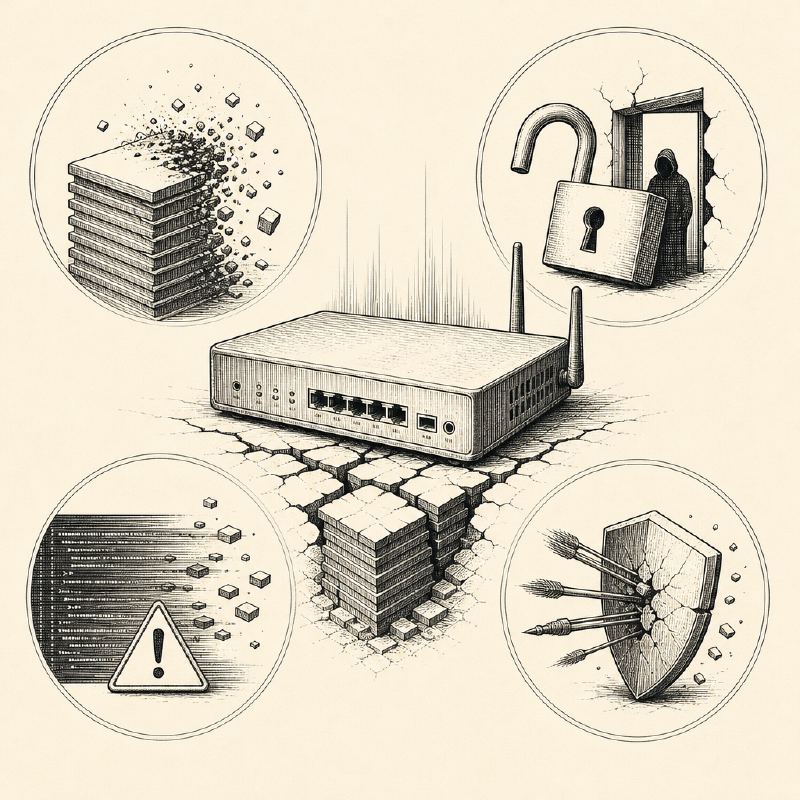

Key findings
- Four vulnerabilities disclosed for Netcore NR256CN devices, impacting versions up to 1.5.140116.
- Critical stack overflow (CVE-2026-111711) and NULL pointer dereference (CVE-2026-111710) in Boa web server.
- Unauthenticated file write (CVE-2026-112016) and authentication bypass (CVE-2026-111712) also present.
- Vulnerabilities range from Medium (6.5) to Critical (9.8) CVSSv3 severity.
- Disclosed between October 16-18, 2026, affecting the Boa web server.
On October 16-18, 2026, a batch of four vulnerabilities was disclosed for Netcore NR256CN devices, impacting versions up to 1.5.140116. These vulnerabilities, primarily affecting the Boa web server component, range in severity from Medium to Critical, with one critical flaw carrying a CVSSv3 score of 9.8. The disclosures highlight significant security weaknesses in how the device handles authentication and file operations, potentially exposing sensitive data and system integrity.
One of the most severe issues, CVE-2026-111711, is a pre-authentication stack overflow vulnerability within the Boa web server's user_ok() function. This flaw arises from unbounded strcpy() calls when copying Basic-auth usernames into fixed-size buffers. Remote, unauthenticated attackers can exploit this by sending a username longer than 63 bytes to any protected route, leading to a stack overflow that can be leveraged for code execution or denial-of-service.
Another critical vulnerability, CVE-2026-111710, is a NULL pointer dereference in the user_auth() function of the Boa web server. This can be triggered by unauthenticated attackers sending a malformed Basic Authorization header that lacks a colon. Such a malformed header can cause the web server to crash, leading to a denial-of-service for the device.
CVE-2026-111712 addresses an authentication bypass vulnerability. Attackers can exploit this by prefixing a URI with specific public routes, such as l7_web_auth.cgi or an .ico route. This allows unauthenticated attackers to access protected management CGI handlers, bypassing intended security controls.
Finally, CVE-2026-112016 involves an unauthenticated file write vulnerability in the Boa web server. This flaw allows remote attackers to overwrite, update, and restore staging files by POSTing to a non-existent .cgi pathname. The vulnerability specifically enables writing attacker-controlled content into /tmp/boa_temp.update, potentially compromising system integrity or enabling further attacks.
All identified vulnerabilities affect Netcore NR256CN devices running firmware up to version 1.5.140116. Users are strongly advised to update their devices to a patched version as soon as possible to mitigate these risks. The clustered disclosure of these vulnerabilities underscores the importance of timely patching and security reviews for embedded devices.
The clustered nature of these disclosures, with three out of four vulnerabilities published on October 16, 2026, and the remaining one on October 18, 2026, suggests a coordinated disclosure event. This batch highlights critical security flaws in the Boa web server component of Netcore NR256CN devices, affecting authentication, file handling, and system stability. Users should prioritize applying available patches to protect their networks from potential exploitation.